Quality and compliance
Mill certificate review
A mill certificate is checked against the order and the material standard, with each difference listed for the inspector.
Quality inspectorChat

Custom LLM applications built for production: the right model for each task, hosted or self-hosted, connected to your systems, measured against real examples and kept within your cost and data rules.
A large language model (LLM) can read, summarise, classify, extract and draft text, and with vision models, read images too. Turning that into something a business can rely on takes more than an API key. ShichifukuTekx builds LLM applications that run in production for teams in the UAE, across the GCC and for clients worldwide.
A demo that works on ten examples often fails on the eleventh. Production LLM work is about everything around the model: getting the right context to it, forcing outputs into a structure your systems can use, handling the cases it gets wrong, keeping costs predictable as usage grows, and knowing when a new model version makes results better or worse. We treat that as engineering, with tests, versioning and monitoring like any other software.
There are five common ways to put an LLM to work, and most projects combine two or three:
ValveVision uses Gemini vision to read valve nameplates, castings and tags from photos and map the values to ASME, API and ISO terms, with consistency checks on the result. Our RFQ automation extracts line items and specifications from long PDF and Excel tenders into editable quotes. Remote inspections combine Gemini with YOLOv8 to flag hazards in live video. Hivelock, our AI agents platform (currently in beta), works with any OpenAI-compatible model, including local Ollama and LM Studio servers, with a fallback order and a confidential mode.
Models improve and prices change every few months. We keep the model behind a thin layer, store prompts and evaluation sets with the code, and rerun the tests when a new model appears, so switching provider is a measured decision rather than a rewrite. If your next step is an assistant that also takes actions, see AI agent development.
The model is one step. The steps around it make the output safe to use.
A document, message, photo or form, from your app, inbox or API.
Relevant records and passages from your data, plus instructions and examples.
The model chosen for this task: hosted, or self-hosted when data must stay inside.
Checked against a schema and business rules; failures retried or sent to a fallback model.
Low-confidence or high-impact results go to a person before they are used.
Structured output delivered to your system; quality, latency and cost recorded.
Specific jobs this service does, not general promises.
The choice is made per use case, not once for the whole company. Many systems use both: a self-hosted model for sensitive steps and a hosted one where quality matters most.
| Factor | Hosted API (OpenAI, Gemini) | Self-hosted open model (Ollama) |
|---|---|---|
| Where data goes | To the provider, under your account and their data terms | Stays on your servers or in your cloud region |
| Quality on hard tasks | Usually the strongest available | Good on focused tasks; weaker on complex reasoning |
| Cost pattern | Pay per use; low to start, grows with volume | Hardware or GPU capacity; fixed, better at steady high volume |
| Speed to start | Days | Weeks, including sizing and hosting |
| Upgrades | New models available as soon as released | You choose when to move, after testing |
| Works offline or on site | No | Yes, including edge hardware |
A written scope you can hold us to.
Every step ends with something you can see.
We pick the task with the clearest value, gather real examples and the correct outputs, and agree the accuracy, speed and cost targets.
Several hosted and open models run on the same examples, so the choice rests on measured results, not on benchmarks from someone else's data.
We build the application around the chosen model: context, retrieval, structured outputs, integrations and guardrails.
The evaluation set runs on every change; a pilot group uses the system and their corrections become new test cases.
Monitoring of quality, latency and spend, model upgrades tested before rollout, and new tasks added on the same foundation.
Projects built with this service.
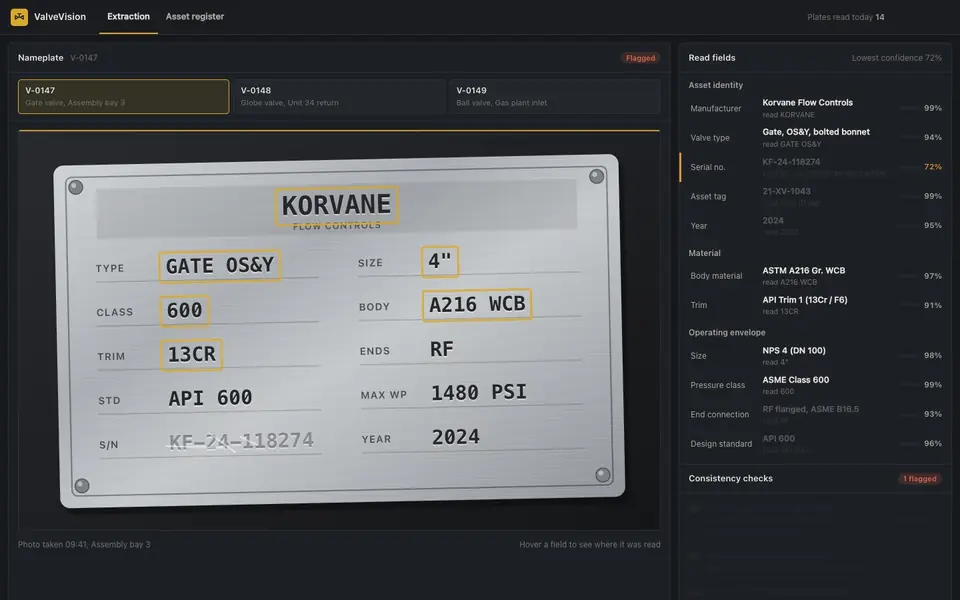
Vision AI that reads nameplates, castings and tags from up to three photos per valve, maps the data to ASME, API and ISO terms and checks it for consistency.
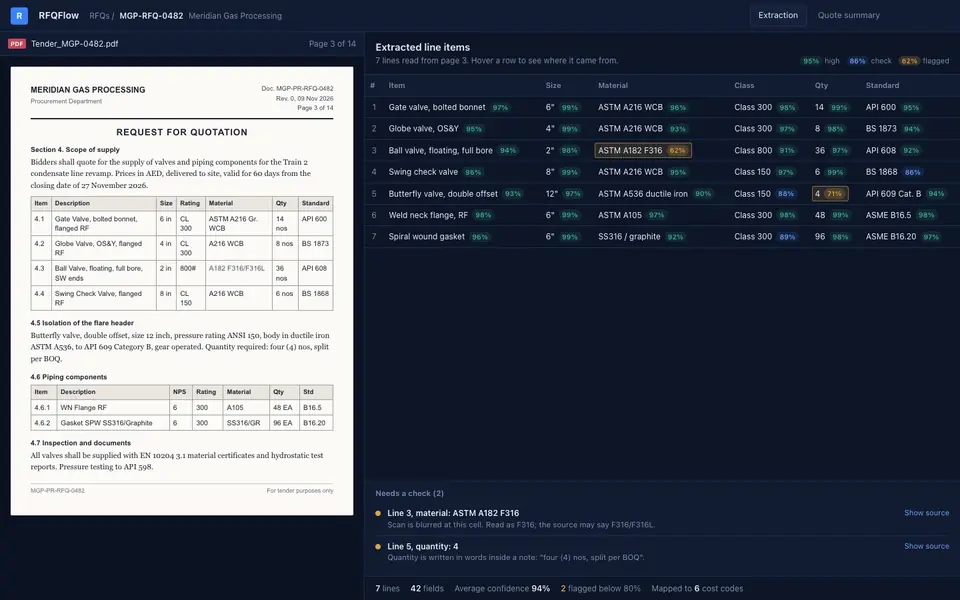
An RFQ platform that reads PDF and Excel tenders, extracts line items and specs, and moves each quote through comparison and approval in one place.
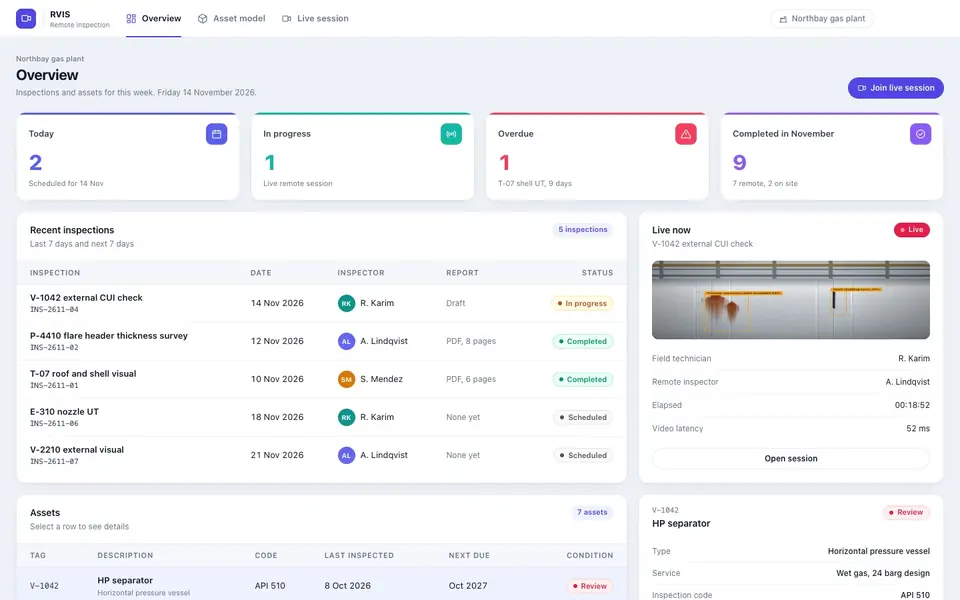
Live remote inspections with sub-100 ms WebRTC video, AR annotations, Gemini and YOLOv8 hazard detection, digital checklists and one-click PDF reports.
Ready agents built with this service, running on Hivelock and connected to your systems.
A mill certificate is checked against the order and the material standard, with each difference listed for the inspector.
Notes from the shop floor become a complete non-conformance draft for the right plant, ready for the quality engineer.
A proposed change gets a full impact check across design, process, supply and documents before it is approved.
A clear list of the documents an order must deliver, with what is already in hand and what is missing.
Ask for a report in plain words and get the table in seconds, with totals, ready to save as a spreadsheet.
Anyone can ask how something is done and get the answer with the procedure and section it came from.
LLM development is building software that uses a large language model to read, extract, classify, summarise or draft text as part of a business process. It covers choosing the model, designing prompts and context, connecting it to your data and systems, validating its outputs, and measuring and monitoring quality in production.
Almost never. Training a model from scratch costs far more than most businesses will recover. Existing models, given the right context through retrieval and good prompts, handle most business tasks. Fine-tuning an existing open model is the next step when that is not enough, and it is much cheaper than training from scratch.
Use RAG when answers must come from documents or data that change, need citations or depend on who is asking. Consider fine-tuning when you need a consistent output format, a specific style or a narrow task done at high volume with a smaller model. We decide based on results on your own examples, and often the answer is RAG with good prompts and no fine-tuning.
It depends on the task, the language, your data rules and your budget, and the answer changes as models improve. We compare several hosted and open models on your own examples and choose per task. Keeping the model behind a thin layer means you can switch later without rebuilding the application.
Yes. Open models can run through Ollama or another OpenAI-compatible server on your own hardware, in your private cloud or in a UAE cloud region, so prompts and documents never leave your environment. Self-hosted models need GPU capacity and careful sizing, and they are usually weaker than the best hosted models on complex reasoning, so we test them on your tasks before you commit.
We give it the facts it needs through retrieval, instruct it to answer only from them and to say when it cannot, and validate structured outputs against rules before they are used. An evaluation set with known answers runs on every change. For anything with consequences, a person reviews the output before it is acted on.
The strongest current models read and write Arabic well, though quality varies between models and between Modern Standard Arabic and dialects. We include Arabic examples in the model comparison and the evaluation set, so the choice reflects how each model performs on your Arabic content.
It starts with a 2 to 3 week fixed-price discovery sprint. A focused application such as extraction or classification for one document type can reach a pilot within a few weeks after that. Cost depends on the number of integrations, how much data needs preparing, the accuracy target and whether models are hosted or self-hosted. Running cost is estimated from your expected volume before you commit.
Book a 30-minute call or send us a project brief.