Quality and compliance
Mill certificate review
A mill certificate is checked against the order and the material standard, with each difference listed for the inspector.
Quality inspectorChat

RAG systems that answer from your own documents, manuals and records, cite the page each answer came from, respect who may see what, and say so when the answer is not there.
Retrieval-augmented generation (RAG) gives a language model the right pages from your own content at the moment a question is asked. The model writes its answer from those pages and cites them, so people can check every claim. ShichifukuTekx designs and builds RAG systems for operations, quality, engineering and support teams in the UAE, across the GCC and for clients worldwide.
A general model knows the public internet up to its training date. It does not know your SOPs, contracts, drawings, price lists or last month's audit findings, and when it is asked about them it may produce a confident answer that is wrong. Fine-tuning a model on your documents does not fix this reliably either: facts change, and a tuned model cannot show where an answer came from. RAG keeps the knowledge in your systems and fetches it fresh for every question.
Our RFQ automation work reads PDF and Excel tenders that run to hundreds of pages, finds the line items and specifications, and matches them against catalogue data using vector search with reranking. In Trevaq, our quality management system, an AI assistant helps teams prepare for audits from their own controlled documents and records. Hivelock, our AI agents platform (currently in beta), gives every agent a knowledge base it searches before it answers.
Most RAG prototypes fail on the same things: scanned PDFs, tables split in half, near-duplicate versions of the same procedure, Arabic and English mixed in one file, and questions that use a part number rather than a description. We test retrieval on your actual documents before we tune any prompt, and we keep hybrid search because exact identifiers matter in operations, engineering and quality work.
If the answer needs an action as well as information, such as raising a ticket or drafting a quotation, the RAG system becomes a tool inside an AI agent. If you are still choosing between models, hosting or fine-tuning, see LLM development.
Every answer follows the same path, and every step is logged.
SharePoint, drives, email, ERP records and scans, collected again when they change.
OCR, split by headings and tables, tagged with source, date, language and access.
From chat, Teams, WhatsApp or an API, along with who is asking.
Meaning and exact terms searched together, filtered by permission, then reranked.
Written only from the passages found, each one cited; declines when they do not cover it.
Tested against real questions on every release; gaps show up in the logs.
Specific jobs this service does, not general promises.
Three ways to get your knowledge into a language model. Most business systems need RAG; some add fine-tuning later for style or format.
| Question | Prompt only | RAG | Fine-tuning |
|---|---|---|---|
| Best for | Short, stable instructions that fit in one message | Large or changing document sets that answers must come from | A consistent format, tone or narrow task the model repeats |
| Keeps facts current | Only what you paste in each time | Yes: documents are re-indexed when they change | No: new facts need another training run |
| Shows its sources | No | Yes: every answer cites its passages | No |
| Respects access rights | Not applicable | Yes: retrieval filters by user permissions | No: anything in training is available to every user |
| Effort to start | Hours | Weeks, mostly document preparation and evaluation | Weeks to months, plus labelled training data |
| Running cost | Grows with prompt length | Search plus a shorter, focused prompt | Hosting a custom model or paying a premium per call |
A written scope you can hold us to.
Every step ends with something you can see.
Two to three weeks: we collect sample documents and 50 or more real questions with their correct answers, map the sources and access rules, and agree what good looks like.
We build ingestion and search on your documents and measure whether the right passages come back before any answer is generated.
We add the model, citations, refusal when the content is missing, permission filters and logging, then test against the question set.
A small group uses it in their daily work; unanswered and corrected questions feed back into the content and the evaluation set.
Wider rollout, scheduled re-indexing, monitoring of answer quality and cost, and support as your documents and models change.
Projects built with this service.
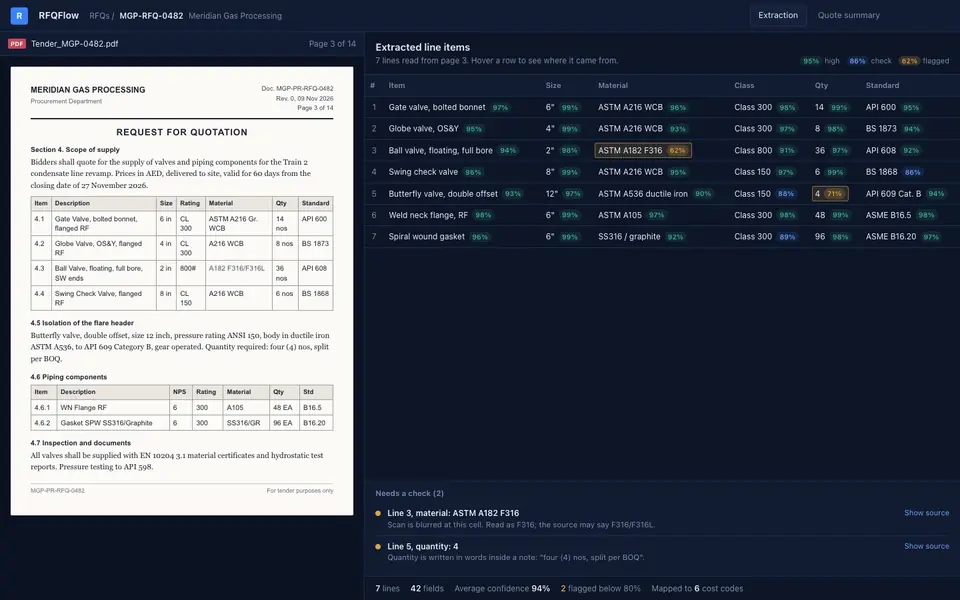
An RFQ platform that reads PDF and Excel tenders, extracts line items and specs, and moves each quote through comparison and approval in one place.
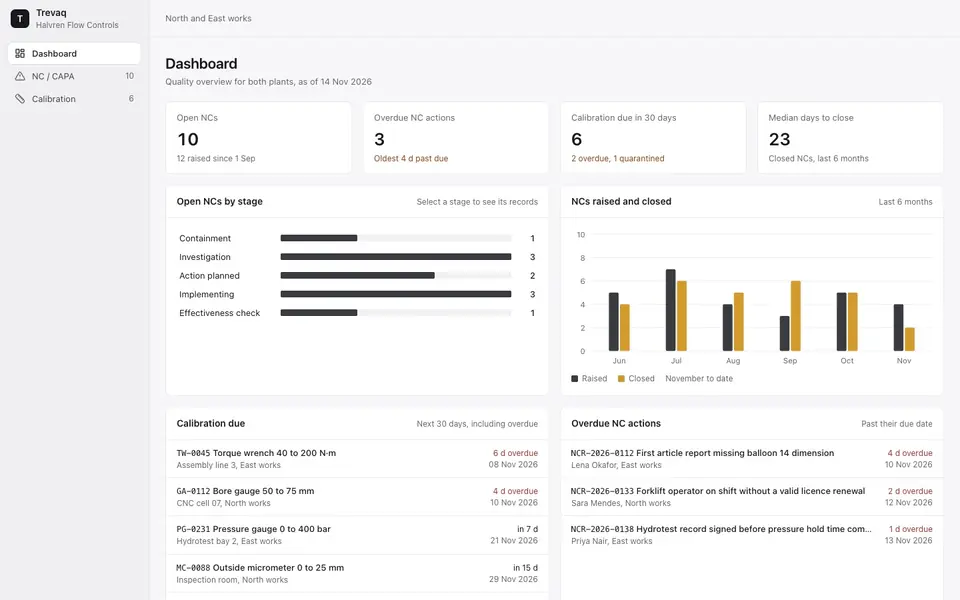
A Trevaq deployment covering ISO 9001, IATF 16949, AS9100 and FDA/GMP: documents, audits, CAPA, suppliers and SPC, with an AI assistant for audit prep.
Ready agents built with this service, running on Hivelock and connected to your systems.
A mill certificate is checked against the order and the material standard, with each difference listed for the inspector.
Each valve RFQ is checked for missing technical data, with the questions for the customer drafted on day one.
A proposed change gets a full impact check across design, process, supply and documents before it is approved.
A clear list of the documents an order must deliver, with what is already in hand and what is missing.
Anyone can ask how something is done and get the answer with the procedure and section it came from.
A guided root cause and corrective action draft that follows your procedure and does not stop at human error.
RAG (retrieval-augmented generation) development is building a system that searches your own content for the passages relevant to a question and gives them to a language model to write the answer, with citations. The work is mostly in preparing documents, building search that finds the right passages, controlling access and measuring answer quality, not in the model itself.
The model is instructed to answer only from the passages it was given, to cite them, and to say when they do not contain the answer. We test this with questions whose answers are not in your documents, so the system learns to decline instead of guessing. RAG reduces wrong answers a great deal, but it does not remove them, so answers that lead to an action stay reviewable.
For answering questions from business documents, usually yes: RAG keeps facts current, shows its sources and respects access rights, none of which fine-tuning does. Fine-tuning helps when you need a fixed output format, a house style or a narrow repeated task. The two can be combined, and we decide based on measured results on your own data.
Yes. Scanned pages go through OCR, tables are kept together with their headings, and spreadsheets are indexed by sheet and row so values can be cited. Poor scans and complex drawings lower accuracy, so we measure extraction quality on your own files during discovery.
Yes. We use embedding models that handle both languages and keep keyword search alongside vector search, because product codes and names are often written in English inside Arabic documents. We include Arabic questions in the evaluation set so quality is measured in both languages, not assumed.
The index and documents can run on your own servers, in your private cloud or in a cloud region you choose, including the UAE regions offered by the major cloud providers. The language model can be a hosted API under your own account or a self-hosted open model, so prompts and documents never leave your environment.
It starts with a fixed-price discovery sprint of 2 to 3 weeks that produces a working prototype on your documents and a costed plan. The rest depends on how many sources, formats and permission rules are involved and how strict the accuracy target is. Running cost is mainly the model calls and hosting, which we estimate from your expected question volume.
Agentic RAG lets an agent decide what to search, run several searches and check its findings before answering, which helps with questions that span many documents. Graph RAG adds a map of entities and relationships, such as which supplier provides which part, for questions about connections. Both add cost and complexity, so we use them only where a plain hybrid search measurably falls short.
Book a 30-minute call or send us a project brief.