AI Development, Data & Analytics
Custom AI and machine learning development on your own data: forecasting, computer vision, document intelligence, predictive maintenance and the dashboards that put it to use.
Most companies already hold the data to plan better. It sits in ERP tables, spreadsheets, machine logs and PDF reports that nobody has time to join up. ShichifukuTekx turns that material into forecasts, dashboards and alerts that operations leaders use, for clients in the UAE, the GCC and international markets.
What does a demand forecasting project involve?
A forecasting project starts with history: sales or consumption by item, location and week, plus anything that explains the swings, such as promotions, seasons, Ramadan, project schedules or lead times. We clean and join that data, test several models against periods you already know the answer for, and keep the one that performs best on your items. Forecasts then feed purchasing, production or staffing plans, with clear confidence ranges rather than a single number.
What we build:
- Demand forecasting by item, site and period, delivered through ForecastIQ or inside your own tools.
- Dashboards that show the few numbers each role needs, refreshed automatically.
- Data pipelines from Dynamics 365, Odoo, IoT sensors and spreadsheets into one PostgreSQL store.
- Predictive maintenance models that read sensor and maintenance history to flag equipment at risk.
- Document intelligence that pulls fields from invoices, certificates, delivery notes and inspection reports into structured data.
- Computer vision models, such as YOLOv8, for counting, inspection and defect detection.
We build in Python with PyTorch or TensorFlow where machine learning is needed, and keep simpler statistical methods where they work as well. Outputs can feed AI agents that act on them, or custom software that puts them in front of the right people.
What changes for your team
What you get from us
A written scope you can hold us to.
- Data audit of ERP, IoT, spreadsheet and document sources
- Data pipelines into a central PostgreSQL store
- Data quality checks and alerts on missing or odd values
- Demand forecasting models with back-tests on your history
- Role-based dashboards for operations, sales and management
- Predictive maintenance models and alert rules
- Document extraction for invoices, certificates and reports
- Model monitoring and scheduled retraining
- Documentation and user training
- Custom models with evaluation reports on your own data before release
From first call to production
Every step ends with something you can see.
- 01
Discovery sprint
Two to three weeks to audit data sources, agree the decisions to support and run a first back-test on your history.
- 02
Connect and clean
We build pipelines from ERP, IoT and documents, and add quality checks so problems surface early.
- 03
Model and visualise
We train and compare models, keep the best performer and present results in dashboards each role can read.
- 04
Deploy and train
Models and dashboards go live on private cloud, a cloud region you choose or edge, and we train your users.
- 05
Monitor and improve
We track accuracy over time, retrain on new data and add sources or use cases as needs grow.
Ways to work with us
Work built with this service
Projects built with this service.
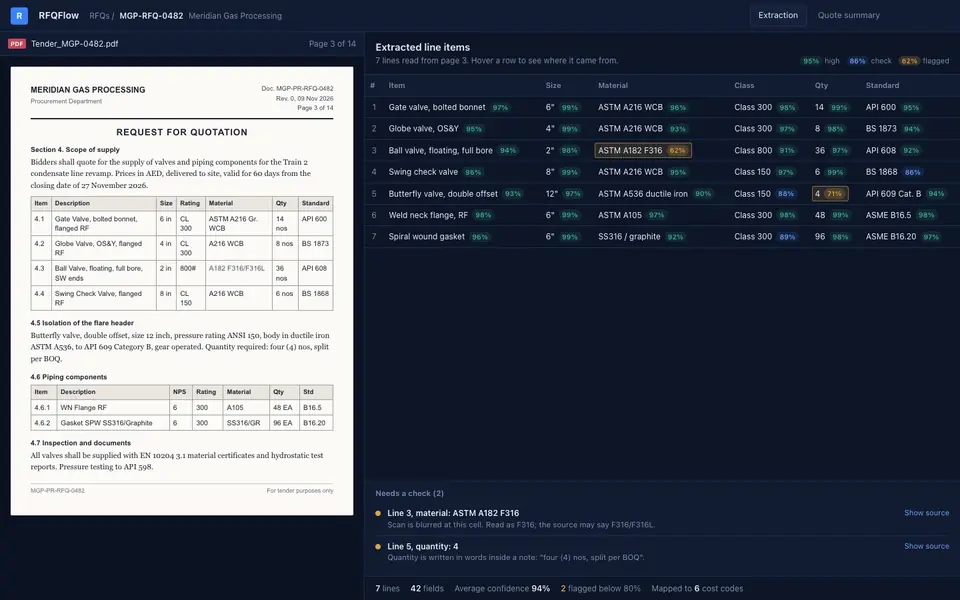
RFQs parsed from PDF and Excel into editable quotes
An RFQ platform that reads PDF and Excel tenders, extracts line items and specs, and moves each quote through comparison and approval in one place.
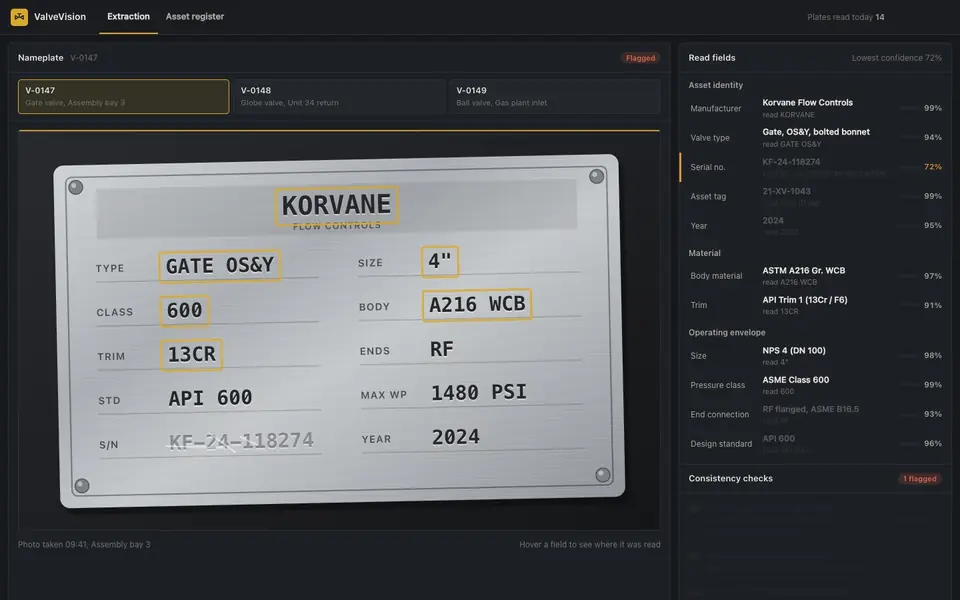
ValveVision reads valve nameplates into a searchable asset register
Vision AI that reads nameplates, castings and tags from up to three photos per valve, maps the data to ASME, API and ISO terms and checks it for consistency.
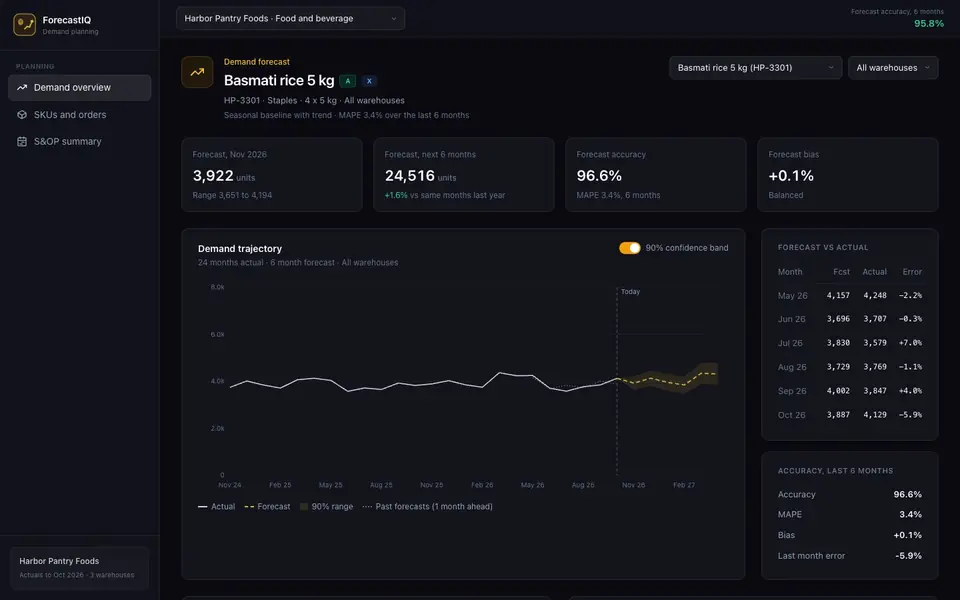
ForecastIQ plans demand and stock across several warehouses
Demand forecasting, inventory planning and S&OP per SKU and per warehouse, with approved replenishment written back to Dynamics 365 Business Central.
Questions about this service
What kind of AI do you develop?
Mostly models that work on operational data: demand forecasting, predictive maintenance, computer vision for inspection and counting, and document extraction. We also build applications on top of large language models, such as search over your documents, with tests that show how often answers are right.
How much historical data do we need for demand forecasting?
More is better, but useful forecasts often start with one to two years of sales or consumption history by item and location. Longer history helps capture seasonality such as Ramadan or summer patterns. During discovery we back-test models on your actual data, so you see how accurate forecasts would have been before you rely on them.
How long does a forecasting or analytics project take?
A 2 to 3 week discovery sprint produces a data audit and a first back-tested model. Moving to production, with automated pipelines, dashboards and integration into planning, typically takes a few more weeks to a few months, depending on the number of data sources and how clean they are.
What is the difference between a dashboard and predictive analytics?
A dashboard shows what has happened and what is happening now: sales, stock, output, downtime. Predictive analytics estimates what is likely to happen next, such as demand for an item next month or the chance a machine will fail. We often build both, with the dashboard showing forecasts alongside actuals.
Can you extract data from PDFs and scanned documents?
Yes. Our document intelligence pipelines read invoices, certificates, delivery notes and inspection reports, including scans, and extract fields into structured data. Models can run on hosted services or self-hosted on your servers. Low-confidence results are routed to a person to check, so errors do not flow silently into your systems.
Can predictive maintenance work with our existing machines?
Often, yes. If your machines already log data or have a maintenance history in ERP, we can start there. Where data is missing, we can add sensors through our embedded and IoT work. We begin with the assets where downtime costs most and a clear failure pattern exists in the data.
Can you connect analytics to Dynamics 365 or Odoo?
Yes. We build pipelines that pull sales, stock, purchase and maintenance data from Microsoft Dynamics 365 and Odoo into a central database for analysis. Forecasts and recommendations can be written back, for example as suggested purchase quantities, so planners work inside the ERP they already use.